|
Dr. Sun Yat Sens Penang Base
at ,Penang, Malaysia

is one of a row of late 19th century shophouses on Armenian Street. It was built by a Straits Chinese circa 1880.
It is a fine example of a Penang shophouse, with an intimate courtyard garden, a handsome timber staircase and an old-fashioned Nyonya kitchen.
In 1926, the shophouse was bought by a Chinese merchant Chng Teong Swee. His grand-daughter Khoo Salma Nasution maintains the shophouse today.
The shophouse is currently the address of Areca Books and Lestari Heritage Network.
COURTYARD GARDEN
A special feature of the shophouse is the atrium around a central courtyard. A shophouse may have one or more inner courtyards. They serve as air-wells for ventilating the often long and narrow buildings.
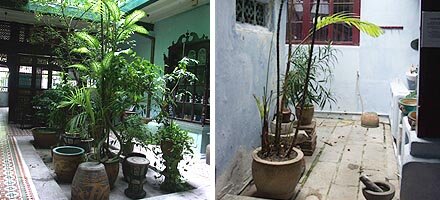
The front courtyard is usually attractively decorated with plants, improving the ambience of the living space.
The back courtyard, where the water tank and bathroom are located, serves as a washing area.
NYONYA KICHEN
The kitchen is the domain of the womenfolk, the Nyonya. The kitchen in this house retains its original 1920s firewood stove.

It also showcases some cooking implements, including a pewter steamboat, a wooden noodle press, a copper water boiler, two charcoal burners, wooden rice tubs, clay curry pots and enamel tiffin carriers.
 PENANG SHOPHOUSE ARCHITECTURE PENANG SHOPHOUSE ARCHITECTURE
A shophouse is by definition a terraced house that combines the functions of a shop and house. However, in Penang, terraced houses are generically called shophouses, even if, as in the case of , they were designed chiefly for residential use.
Like other shophouses in Malaysia and Singapore, the Penang shophouse is typically a long, double-storey building with a narrow frontage. The five-footway or front verandah of a row of such houses join up to create a continuous arcade. Internally, timber partitions and a largely timber upper floor span an otherwise solid masonry building with thick party walls.

Armenian Street in George Town, Penang, runs between Chulia Street (named after the South Indians) and Acheen Street.
An Armenian community lived in Penang in the early 19th century. However, they did not stay long in this neighbourhood, preferring to build their church in Bishop Street, a few blocks north, in 1822. The name Armenian Street remains, although the neighbourhood was already overtaken by the Straits Chinese in the mid-19th century.
The most famous Armenians in Penang were the Sarkies brothers, who ran the Eastern & Oriental Hotel, established 1885.
Recommended reading: Nadia H. Wright, Respected Citizens: The History of Armenians in Malaysia and Singapore www.amassia.com.au
The firewood stove and kitchen cupboard
The house at belonged to a Pitt Street trader Lim Boon Yeow from 1900 to 1913.
Why was this address chosen to be the premises of the Tung Meng Hui headquarters?
The long, narrow shophouse provided an escape route should a raid be staged from the front of the house, the back door led into the Indian Muslim villages of Kampong Kaka and Kampong Kolam. The urban villages were cleared for a road in the 1920s.
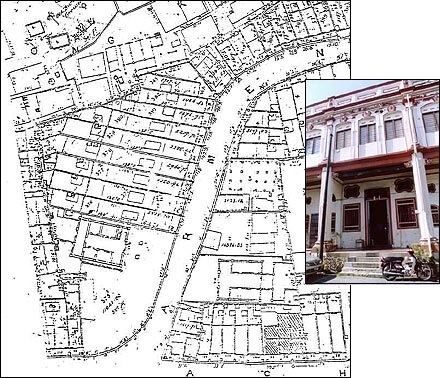
The site was located in a Straits Chinese residential enclave, away from the main commercial streets.
On the adjoining street was the Acheen Street Mosque and a neighbourhood of Arabs, Sumatrans and Malays. The Tongmenghui branch chairman Wu Shirongs house was also at 25 Acheen Street.
.
|


