|
Descendants of the White-Blooded Lady
 It could have happened anywhere, in any age. The young wife talks to a handsome stranger while her husband is away, and is accused of adultery. But for Mahsuri, the wife of Wan Darus of Langkawi, the price of indiscretion was death. The tragic legend of Mahsuri has become synonymous with Langkawi, but she is believed to hail from another famous island resort, Phuket. It could have happened anywhere, in any age. The young wife talks to a handsome stranger while her husband is away, and is accused of adultery. But for Mahsuri, the wife of Wan Darus of Langkawi, the price of indiscretion was death. The tragic legend of Mahsuri has become synonymous with Langkawi, but she is believed to hail from another famous island resort, Phuket.
Mahsuri's tragedy could simply have resulted from a cultural misunderstanding between two quite different Muslim societies. Seven generations ago, Phuket was marginally Muslim, whereas Hadhrami Arabs already had a presence in Langkawi and Kedah. The sociable behaviour of an islander girl from Phuket was most likely frowned upon by the more orthodox noble families of Langkawi.
 When Mahsuri's body was pierced, a fountain of white blood issued forth. Those who witnessed the execution took this as indisputable proof of Mahsuri's innocence. Her family and followers fled to Phuket whence they came, bringing with them Mahsuri's son Wan Arkem. When Mahsuri's body was pierced, a fountain of white blood issued forth. Those who witnessed the execution took this as indisputable proof of Mahsuri's innocence. Her family and followers fled to Phuket whence they came, bringing with them Mahsuri's son Wan Arkem.
What of Mahsuri's white blood? The 'white-blooded lady' is a protagonist of several founding myths in Southern Thailand. This legend has variations as far south as Perak, where the first noble family of Perak is believed to have been descended from a white-blooded Semang woman. Both Kedah and Perak were formerly under Siamese dominion and were culturally part of Southern Thailand, dubbed by a scholar as 'the land of the white-blooded lady'.
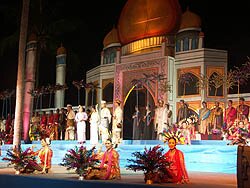
The legend of Mahsuri was recently re-enacted by the Phuket Rajhabhat University with a budget of two million baht (about RM 200,000) from the Phuket provincial government. This extravagant 'light-and-sound' show was the highlight of the 'Halal Food, Hilal Town' festival.
'For this production, I distilled the narrative from ten different versions of the Mahsuri legend,' said the show's producer, director, script-writer and acting coach, Sawit Pongwat, director of the university's arts and culture department.
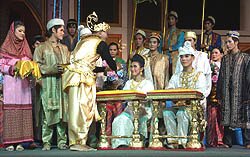 The result was a Thai-style drama, with the tari bunga and tari kipas performed by Thai university students. But the simplicity of the plot was understandable - after all, this is the first time that the legend of Mahsuri has been staged on Thai soil, in Thai language and to a Thai popular audience. The result was a Thai-style drama, with the tari bunga and tari kipas performed by Thai university students. But the simplicity of the plot was understandable - after all, this is the first time that the legend of Mahsuri has been staged on Thai soil, in Thai language and to a Thai popular audience.
At the start of the show the main actors and their characters were introduced one by one. Three different girls played Mahsuri, to avoid the need for quick costume changes. The costumes themselves were magnificent and the 'light-and-sound' was put to dramatic effect to simulate the lighting, thunder and typhoon that struck Langakawi during Mahsuri's execution.
At the end of the show, Sirintra and her extended family were brought to the front of the line-up and presented as the living descendants of the legendary 'Siamese Muslim princess'. Their dress and appearance made me think that the Kamala folk could have come from a Malay kampong in Malaysia. But this illusion of Malay-ness was immediately dispelled by the playing of the Thai national anthem.
 The star of the show was Sirintra Yayee of Kamala. Hers is a modern fairy-tale of sorts. Sirintra, whose Muslim name is Aishah, was 'discovered' as a child when the Kedah Historical Society confirmed her as the first seventh-generation descendant of Mahsuri. The star of the show was Sirintra Yayee of Kamala. Hers is a modern fairy-tale of sorts. Sirintra, whose Muslim name is Aishah, was 'discovered' as a child when the Kedah Historical Society confirmed her as the first seventh-generation descendant of Mahsuri.
As a teenager, she was whisked away to Malaysia to visit Mahsuri's tomb in Langkawi and to meet the then Prime Minister Dr. Mahathir Mohamed. She was then awarded an Utusan Malaysia scholarship to attend the International Islamic University in Kuala Lumpur, where she is learning English and taking a course in communications.
Although she has a younger 13-year old brother, Mohamed Jihan, a direct male descendant of Mahsuri, the Malaysian press have decided to focus on Sirintra, hailing her as a true 'likeness' of Mahsuri. She appeared indifferent to giving yet another interview. 'It's great that they (the Malaysians) recognize and accept me, but sometimes I wonder why they did not accept her (Mahsuri)', said the 19-year old.
Sirintra's family lives in the main town of Kamala, just off the undulating coastal road from Phuket airport to Patong. 'Kamala' is a Thai word which denotes 'beautiful lady', but it was originally pronounced 'Gamara', which some people believe comes from the Malay word pengembara, meaning traveller or sojourner. Apart from the Langkawi families, Kamala also had families whose forefathers came from Kedah and Kelantan. The former Imam of Kamala Mosque came from Johore and spoke Malay.
 Next to the main mosque of Kamala, hidden behind some new concrete houses, is a large Malay house, with tall, old fruit trees on the hillslope behind it. Made of durable hardwood and raised on posts with a stairs and porch (anjung) at one end, the ancestral home of the Yayee family was built by Wan Hussein, Sirintra's great-grandfather. It is one of the few vernacular buildings in Phuket that could be said to represent Muslim heritage. The walls have not been tarted up by modern paint, but retain the vintage ferrous-red wash. Next to the main mosque of Kamala, hidden behind some new concrete houses, is a large Malay house, with tall, old fruit trees on the hillslope behind it. Made of durable hardwood and raised on posts with a stairs and porch (anjung) at one end, the ancestral home of the Yayee family was built by Wan Hussein, Sirintra's great-grandfather. It is one of the few vernacular buildings in Phuket that could be said to represent Muslim heritage. The walls have not been tarted up by modern paint, but retain the vintage ferrous-red wash.
Like many Kamala men, Sirintra's father Wan Nawawi alias Suwan Yayee is a tut-tut driver. Her mother Wan Sumaini binti Karim alias Sunee Doomlak, is also a Mahsuri descendant. Sirintra's maternal uncle, Khun Wissanu Doomlak, is the provincial councillor (equivalent to a state assemblyman in Malaysia) representing the district of Kamala, Patong and Kathu.
During the previous elections, the former Kamala school teacher helped to deliver the minority Muslim votes to Democrat Party, the national opposition which now controls the Phuket provincial administration. Throughout the festival he was dressed in songkok, baju Melayu and samping, playing his role as one of the festival organisers.
According to Khun Wissanu, also known as Ahmad bin Karim, Mahsuri's people first lived by the sea in Kamala. Then when the beach land was taken up for tin-mining, the villagers moved to the foothills. The mosque moved with them, leaving behind the cemetery. The Thai Muslims in Kamala tended to fruit orchards and worked in the Chinese-owned tin mines. When tin-mining collapsed in the mid-1980s, they looked for tourist jobs in nearby Patong.
The beach and coastal road in Kamala has already been zoned as an entertainment district, where bars, discos and karaoke joints are allowed. 'Many Kamala Muslims sell their land to outsiders,' said Khun Wissanu. 'In ten years time, Kamala beach will be like Patong. The beach will be the place for business, the people will move to the foothills. Only the cemetery by the sea will show that the Muslims were once there.'
Khun Wissanu gave me the geneaology of the Yayee family. Sirintra is the eldest child of Wan Nawawi, the son of Wah Hasheen alias Chern Yayee, the son of Wan Hussein, the son of Wan Hakay, the son of Wan Agim, the son of Mahsuri. That makes her the the first-born seventh generation descendant of Mahsuri.
Mahsuri's son Wan Arkem, had six children, two sons and four daughters. Their descendants form six sub-clans in Kamala, bearing four different clan names, Yayee, Doomlak, Samerpurn and Sungwarn. Other families such as the Sangthong, the Sariya and the Sooksrisin also intermarried with Mahsuri's progeny.
The descendants of Wan Arkem's sons Wan Hakay and Wan Heed carry the clan name 'Yayee'. Other descendants carry the names of the daughter's husband's families. Wan Phau and Wan Maw married two brothers (or cousins) of the 'Doomlak' family, Wan Deng married Mahsuri's guard 'Samerpurn'. Wan Phek married 'Sungwarn', which means 'belt' in Thai. Wan Akerm gave each of his children a dagger, which all the six clans still possess as proof of their lineage.
Thanks to Khun Wissanu's influential position, the story of Mahsuri has now been retold to a Thai audience. A 'Princess Mahsuri Museum' is already in the pipeline. Whether or not the Mahsuri legend becomes as famous in Phuket as it has in Langkawi, the descendants of the 'white-blooded lady' deserve to be proud of their family heritage, and the role they are playing to help reverse the fortunes of Kamala after the tsunami.
Text and photos copyright Khoo Salma Nasution
.
|