Phuket's Old Town Movement
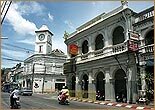
" History
" Architectural Heritage
" The Phuket Shophouse
" Urban Conservation
" Old Phuket Foundation
.
The Halal Festival In Kamala

" Click here for full story
.
Remembering Princess Mahsuri
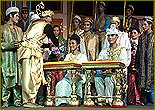
" Click here for full story of the tragic princess from Phuket, and her descendants

|
The Halal Festival In Kamala
 
Phuket provincial government head Khun Anchalee Wanich Thepabutr wants to tell the world that Phuket is a safe place to visit. 'We want to show how the Muslims in Phuket live in harmony with Thai Buddhists and foreign nationalities,' she said, officiating the opening of the 'Halal Food, Hilal Town' festival in Kamala beach, just north of Patong. On stage, children released 39 doves, representing the hope for peace in Southern Thailand.
 Thai Muslims make up about 30 percent of Phuket's population. In contrast to the Thai Muslims who live in Pattani, Yalla and Narathiwat, the Phuket Muslims speak Thai, not Malay. Many of them were originally fishermen and orchard gardeners, living around the beaches which are now international tourism resorts. The host of Phuket's first large-scale Thai Muslim festival was the Kamala community, but Muslims from all over the province pitched in to make it a success. Thai Muslims make up about 30 percent of Phuket's population. In contrast to the Thai Muslims who live in Pattani, Yalla and Narathiwat, the Phuket Muslims speak Thai, not Malay. Many of them were originally fishermen and orchard gardeners, living around the beaches which are now international tourism resorts. The host of Phuket's first large-scale Thai Muslim festival was the Kamala community, but Muslims from all over the province pitched in to make it a success.
The festival, held from 28 July to 1 August, was targeted at attracting Middle Eastern tourists to boost Phuket businesses during the low-season. The festival grounds was a large coconut grove belonging to CocoHut, whose Bangkok owner sponsored the site in the hope that the festival will help bring tourists back to Kamala beach after the tsunami.

The halal food on offer ranged from Thai Muslim fare and skewered kebabs to Chinese dim-sum and Japanese sushi. Crowds stopped to marvel at a showy demonstration of 'teh tarik' which the Thais call 'teh Pattani'. Participating non-Muslim stalls were required to have existing Halal certification, while Muslim vendors had to undergo a one-day training programme conducted by the newly-established Halal Science Centre of the Chulalongkorn University.
Said one of the organisers Charoen Thinkohkeaw, whose Muslim name is Kamarrudin Yahya, 'Arab tourists tend to doubt whether halal food in Phuket is really halal or mashbooh (questionable), so we are upgrading the food industry with technical expertise from the Halal Science Centre.'
 Stall holders were almost equally both Muslims and Buddhists. The organisers did a magnificent job of bringing together a wide range of foods, Thai crafts, textiles, eco-products and OTOP (one tambun one product) award-winners from 14 Southern Thai provinces. Handicrafts included Phuket's unique beaded embroidery on batik sarong. For many bird-lovers, the most exciting event was the bulbul singing contests. A children's Qur'an reading competition was also held. Stall holders were almost equally both Muslims and Buddhists. The organisers did a magnificent job of bringing together a wide range of foods, Thai crafts, textiles, eco-products and OTOP (one tambun one product) award-winners from 14 Southern Thai provinces. Handicrafts included Phuket's unique beaded embroidery on batik sarong. For many bird-lovers, the most exciting event was the bulbul singing contests. A children's Qur'an reading competition was also held.
But the rarest treat of all was to see various Muslim and Malay performing arts of Southern Thailand gathered in Phuket. The Kempulan Bungayaran from Pattani performed the Likay Ulu, a Thai version of Dhikir Barat. Graceful veterans from Krabi performed the martial arts Silat Gayong. The shadow play Wayang Kulit came from Nakhon Si Thammarat.
'Islamic culture is not only Arabic, we have our own traditional Thai Muslim culture,' said Thinkohkeow, a radio broadcaster and advisor of Phuket's Muslim Wittaya School.
 
Some of these performing arts are endangered. Ronggeng, which originated from Penang's entertainment world, was performed by the mature Orang Laut women from the sea gypsy community of Koh Sirey, Phuket. A traditional blessing for month-old infants was enacted by the last of Phuket's Lekia groups, composed of elderly men from the neighbouring village of Bangtao.
The young musicians from Phuket's Islam Phattanah have been nurtured by Malaysia's music academy, Mawaddah, a subsidiary of Rufaqa. The boys played a kompang welcome to the VIPs, while the girls sang Nasyid to a modern beat. The highlight of the festival was an original 'light-and-sound' staging of 'Mahsuri', a legend which links the people of Kamala with Malaysia's Langkawi.

The festival budget of five million baht (about RM 500,000) came from the Phuket provincial government. Pamphlets were produced in Thai, English, Arabic and Chinese but the number of foreign tourists fell below expectation. Although food sales were brisk, handicrafts sales suffered. According to a stall-holder, several flights from Dubai and Malaysia had been cancelled last minute due it a tsunami warning the week before.
Still, the Tourism Authority of Thailand has pledged its support to make the festival an annual affair. Haji Saad, who sold Islamic wear at the fair, was educated in Penang and spoke excellent English. 'I want to welcome more Malaysians to Phuket,' he grinned. With so much to see, and such a warm reception, it is a pity that few Malaysians made it to the fair. But there is always next year.
|
The day the sea rose in Kamala
 The Thai Muslims of Kamala see themselves as having an open attitude. Said 'The Muslims and Buddhists live peacefully together for a long time. The farang (Thai term for foreigner) can come and stay at our village, no problem. But if they want to marry a Muslim girl then they have to convert.' The Thai Muslims of Kamala see themselves as having an open attitude. Said 'The Muslims and Buddhists live peacefully together for a long time. The farang (Thai term for foreigner) can come and stay at our village, no problem. But if they want to marry a Muslim girl then they have to convert.'
Three quarters of Kamala inhabitants are employed in tourism-related jobs, whether driving the tut-tut, taking the farang out on long-tailed boats, or working in hotels and restaurants. The folk of Kamala, 80% Muslim, were thrust into big-time tourism when a multi-million dollar theme park called 'Fantasea' was built in their midst about ten years ago. The easy money from tourism was difficult to resist. Then came the tsunami.
Prasit Sattaman, better known as 'Sit', who lost his job, car and motorcycle, remembers how it happened. 'There was no big wave like in Khao Lak. The water in Kamala just kept on rising until about two metres high. Believe it or not,' said Sit, 'the houses were destroyed, but the mosques and cemetery on the beach stood firm. Just like in Aceh.' 'The foreigners were still sleeping, but many Muslims woke up early to go to the mosque, so they were warned by others. A few Buddhists drowned because they went to the temple near the sea. The kindergarten is also near the sea, if happened on Monday morning, many of our children would have been lost.'
Sit knows of eight locals who perished in Kamala on that fateful Sunday morning after Christmas. Out of the thousands of tsunami deaths in Thailand, most occurred in Phang-nga and the outer islands. Phuket itself recorded only 279 casualties, mainly in the Patong and Kamala beaches.
 Foreign donations poured in to help rebuild the Buddhist Wat in Kamala and to replace the fishermen's long-tailed boats, but to help the private properties. Said Sit, 'Most of the resorts around Patong are foreign-owned, they have money to rebuild. But the Thai owners of the Kamala properties invested everything. The bank will not give them another loan.' Foreign donations poured in to help rebuild the Buddhist Wat in Kamala and to replace the fishermen's long-tailed boats, but to help the private properties. Said Sit, 'Most of the resorts around Patong are foreign-owned, they have money to rebuild. But the Thai owners of the Kamala properties invested everything. The bank will not give them another loan.'
While the 'Halal Food' event was in full swing, many guesthouses were in still shambles or undergoing repair. A signboard at Ban Na Nok, a village in Kamala next to the festival site, welcomed donations of building materials. 'Before the tsunami, everyone in Kamala wanted to build a new guesthouse or sell their land. But the tsunami washed everything away, now everything is quiet,' said Sit.
|
Text and photos copyright Khoo Salma Nasution
.
|
|
